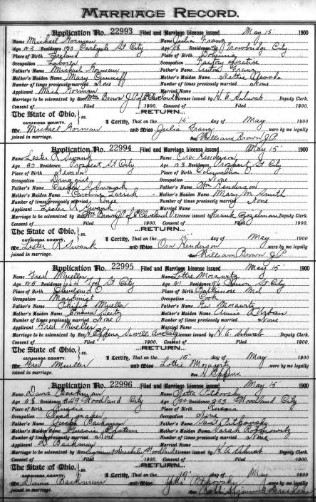
Before marriage certificates became the familiar documents we know today, your ancestors’ marriages were often recorded one after another in large handwritten books. A marriage register may look like a simple list, but an entry can reveal the marriage date, residences, witnesses, parents, officiant, and other clues—and sometimes point you toward additional marriage documents that contain even more.
Introduction
A marriage register is an official book or record in which marriages were entered as they were reported, performed, or registered.
Marriage registers were maintained by county clerks, town and municipal officials, churches, parishes, and other authorities responsible for recording marriages. Depending on the jurisdiction and time period, the register may have been the principal official record of the marriage or one part of a larger recordkeeping system.
For genealogists, marriage registers are especially important because they can cover long periods and contain hundreds or thousands of marriages in a single collection.
But there is an important question to ask whenever you find an ancestor in one:
Is the register entry the complete marriage record, or does it point to another document?
Sometimes the register contains nearly everything recorded about the marriage. In other cases, it is essentially a summary that directs you to a marriage license, certificate, return, application, or another record.
What Might a Marriage Register Contain?
The information varies considerably by jurisdiction, time period, and the purpose for which the register was maintained.
An entry may include:
- Names of the bride and groom
- Date of marriage
- Date the license was issued
- Place of marriage
- Ages of the bride and groom
- Residences
- Birthplaces
- Occupations
- Marital status
- Names of parents
- Names of witnesses
- Name and title of the officiant
- Marriage license or certificate number
- Volume and page references
- Date the marriage was returned or registered
Early registers may contain little more than the names of the couple and a date.
Later registers can be much more detailed, sometimes containing information similar to that found on a marriage certificate.
Who Created the Register?
Understanding who maintained the register can help you understand what the entry represents.
A county clerk might have recorded marriages reported by ministers and other officiants. A town clerk might have entered marriages as part of the community’s vital records. A church might maintain its own register of marriages performed by its clergy.
These are not necessarily interchangeable records.
The same marriage could therefore appear in a church register and a civil register, with each containing somewhat different information.
When you locate one register entry, investigate whether another version of the marriage record survives elsewhere.
The Entry May Have Been Copied from Another Document
The handwriting you see in a marriage register may not belong to someone who witnessed the marriage.
Information was sometimes copied into registers from marriage returns, certificates, licenses, or other documents submitted to the recordkeeping office.
Entries might have been made days or weeks after the ceremony. In some circumstances, older records were recopied into replacement or consolidated volumes.
That distinction matters because transcription can introduce errors.
A clerk could misread a surname, omit information, or copy a date incorrectly.
A marriage register may be an official record while still being a transcription of information originally recorded somewhere else.
If the original marriage return, certificate, or other document survives, compare it with the register entry.
Look Carefully at All of the Dates
A marriage register may contain more than one date.
For example, you might find:
- Date the marriage license was issued
- Date the ceremony occurred
- Date the officiant completed the marriage return
- Date the marriage was registered
These dates can be close enough that it is easy to mistake one for another.
The marriage date is the date the ceremony actually occurred.
If the register contains multiple date columns, read the column headings carefully before entering a date into your family tree.
This is particularly important with digitized collections, where an online index may extract one date without clearly explaining what that date represents.
Certificate and License Numbers Can Be Valuable Clues
One of the easiest details to overlook in a marriage register is a number appearing alongside the entry.
That number may refer to a:
- Marriage license
- Marriage certificate
- Marriage return
- Application
- Separate marriage file
Similarly, a register may provide a book, volume, or page reference leading to another set of records.
Don’t dismiss these numbers as administrative bookkeeping. They may be directions to another document.
If you are viewing the register through an archive or online collection, examine the collection description or catalog to determine whether associated marriage documents also survive.
Pay Attention to Witnesses and Officiants
When witnesses are named, research them.
A witness could be a sibling, parent, cousin, friend, neighbor, coworker, or someone else connected with the couple.
Do not automatically assume a family relationship, but consider whether the same person appears elsewhere in records associated with the bride or groom.
The officiant can also provide an important clue.
A minister, priest, rabbi, or other religious officiant may help identify the congregation with which the couple was associated. That could lead to church marriage records, baptismal records for their children, burial records, or other congregational records.
If the officiant regularly appears in nearby register entries, searching for the church or congregation that person served may open another avenue of research.
Examine the Entries Around Your Ancestor
One advantage of a marriage register is that you can often see the records surrounding your ancestor’s entry.
Don’t immediately close the image after finding the marriage you wanted.
Look at nearby pages and entries.
You may discover:
- Another person with the same surname marrying shortly before or afterward
- The same witnesses appearing at several family marriages
- An officiant associated with multiple relatives
- Couples from the same neighborhood or community
- Another marriage involving a sibling or other possible relative
These patterns may not prove relationships, but they can provide leads worth investigating.
This is one reason viewing the actual register can be more useful than seeing only a single extracted entry in a searchable database.
Marriage Register, Marriage Index, or Both?
The distinction is not always obvious.
A detailed marriage register records information about marriages themselves. A marriage index is primarily intended to help locate marriage records elsewhere.
But some registers contain such brief entries—perhaps only the bride, groom, date, and certificate number—that they function much like indexes for genealogical research.
Conversely, a volume labeled Marriage Book might actually be an index pointing to records in another collection.
The title written on the volume or assigned by a modern repository does not always tell the entire story.
Look at the structure of the entries.
If the register provides a certificate number, book and page reference, or another identifier, determine whether it leads to an additional record.
Don’t Rely Only on the Online Index
Digitized marriage registers are frequently accompanied by searchable indexes.
Those indexes are extremely useful for finding an ancestor’s entry, but they may contain only a portion of the information visible on the original register page.
The searchable result might provide:
John Smith — Mary Jones — 14 June 1887
while the register itself also provides residences, witnesses, an officiant, and a certificate number.
Names can also be incorrectly transcribed when the handwriting is difficult to read.
Whenever an image of the register is available, examine it.
And don’t look only at the highlighted entry. Column headings, marginal notes, page headings, and surrounding records can all help you understand what was recorded.
Where Might You Find Marriage Registers?
Marriage registers may be held by:
- County courthouses and clerks
- Town and municipal offices
- State or provincial archives
- Churches and denominational archives
- Libraries
- Historical and genealogical societies
Many have also been digitized by archives, libraries, genealogy organizations, and commercial genealogy websites.
When searching catalogs, try terms such as:
- Marriage Registers
- Marriage Record Books
- Marriage Books
- Marriage Records
- Marriage Returns
- Marriage Licenses and Returns
- Vital Records
- Church or Parish Registers
If you find only an index or transcription online, determine where the original register is held and whether images are available elsewhere.
Follow the Register Wherever It Leads
Finding your ancestor in a marriage register should not necessarily end the search.
Ask what other records may have been created as part of the same marriage process.
Depending on the jurisdiction, the register could lead you to a:
- Marriage application
- Marriage license
- Marriage bond
- Consent affidavit
- Marriage certificate
- Marriage return
- Church marriage register
Those records may contain information that was never copied into the register.
Think of the marriage register not only as a record of the marriage, but also as a possible doorway to the rest of the marriage file.
Key Takeaways
- Marriage registers were maintained by civil and religious authorities to record marriages.
- The amount of information recorded varies greatly by jurisdiction and time period.
- A register entry may have been copied from a marriage license, certificate, return, or another document.
- Read column headings carefully to distinguish the marriage date from license, return, and registration dates.
- Certificate, license, volume, and page numbers may lead to additional marriage documents.
- Research witnesses and officiants for clues to family and religious connections.
- Examine surrounding register entries for possible relatives and associates.
- A brief marriage register can function much like an index.
- Whenever possible, examine the actual register image rather than relying solely on an online transcription.
- After finding the register entry, investigate whether the underlying or associated marriage documents survive.
Examples