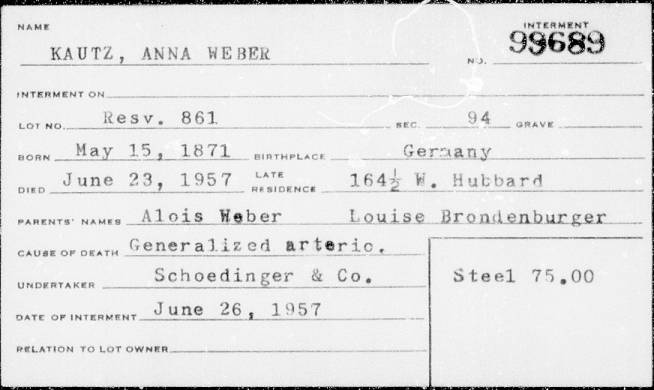
A gravestone tells you who is buried there. A cemetery interment card may tell you who is buried around them—and why.
Created as part of a cemetery’s working records, interment cards can contain burial dates, grave and lot locations, funeral homes, relatives, lot owners, and other details that never made it onto the gravestone. Even better, the names and plot information on one card may lead directly to additional family members buried nearby.
Introduction
A cemetery interment card is an administrative record created by a cemetery to document the burial or placement of an individual within the cemetery.
Depending on the cemetery, these records may also be called:
- Burial cards
- Interment records
- Burial record cards
- Grave cards
- Cemetery cards
- Lot cards
- Burial permits or burial record files
The terminology varies, and cemeteries have used many different recordkeeping systems.
Some interment cards contain only a few basic facts. Others provide a surprising amount of information about the deceased, the burial, the funeral, and the cemetery lot.
For genealogists, their greatest value often comes from something beyond the individual burial:
They can connect the deceased to an entire cemetery plot—and potentially to an entire family.
What Might a Cemetery Interment Card Contain?
Information varies by cemetery and time period, but an interment card may include:
- Full name of the deceased
- Maiden or previous name
- Date of death
- Date of burial or interment
- Age at death
- Birth date
- Birthplace
- Residence
- Place of death
- Cause of death
- Marital status
- Name of spouse
- Names of parents
- Funeral home or undertaker
- Cemetery section
- Lot number
- Plot or grave number
- Grave location
- Name of lot owner
- Date the lot was purchased
- Person authorizing the burial
- Burial permit number
- Removal or reinterment information
- Cremation information
- Notes concerning the burial
Not every card contains all of these items.
But even a card containing only the deceased’s name, burial date, and precise grave location can open another line of research.
Burial Date Is Not the Death Date
Cemetery records frequently emphasize the interment date because that is the event the cemetery was responsible for recording.
Do not automatically treat that date as the date of death.
A person might die on June 3 and be buried on June 6.
Occasionally, the interval can be considerably longer.
If a card provides only an interment date, use it as a clue for locating the death date through:
- Death certificates
- Death indexes
- Obituaries
- Funeral home records
- Newspaper death notices
- Church records
The burial date can also help narrow a newspaper search when the exact death date is unknown.
The Grave Location May Be the Most Important Information on the Card
Section, lot, block, row, and grave numbers can look like administrative details.
Don’t ignore them.
They tell you exactly where the cemetery placed the deceased.
More importantly, they allow you to ask:
Who else is buried in that lot?
That question can produce one of the most valuable discoveries available in cemetery research.
A family plot might contain:
- Spouses
- Parents
- Children
- Siblings
- In-laws
- Grandparents
- Infants
- Previously unknown relatives
Some of those people may not share the same surname.
A married daughter may be buried beside her parents under her husband’s surname. An infant may have no surviving gravestone. An in-law may occupy another grave in the same family plot.
Don’t research only the person on the interment card. Research the entire lot.
Who Owned the Cemetery Lot?
If the interment card identifies a lot owner, pay attention.
The lot owner may be the deceased—but frequently it is someone else.
It might be:
- A spouse
- Parent
- Child
- Sibling
- Son-in-law
- Daughter
- Other relative
- Family friend
- Church
- Fraternal organization
The relationship may not be stated.
That makes the lot owner’s identity a research question:
Why did this person own the burial lot in which my ancestor was buried?
Cemetery lot ownership records, deeds, purchase registers, and correspondence may provide the answer.
A lot purchased decades before your ancestor’s death can also reveal which member of the family originally established the burial plot.
The Person Who Authorized the Burial Can Be a Clue
Some cemetery records identify the person who arranged, authorized, or requested the interment.
That individual deserves attention.
Like the informant on a death certificate, this person may have been closely connected to the deceased.
It could be a:
- Spouse
- Adult child
- Sibling
- Parent
- Other relative
- Funeral director
- Guardian
- Friend
Don’t assume the relationship. Research it.
An unfamiliar name may provide the clue to a relative you haven’t yet identified.
Follow the Funeral Home
If the card names a funeral home or undertaker, you have another research lead.
Funeral home records can contain information not preserved by the cemetery, including:
- Family contacts
- Parents
- Spouse
- Residence
- Occupation
- Funeral arrangements
- Clergy
- Newspaper notices
- Transportation
- Financial information
An older interment card may identify an undertaker whose business no longer exists.
Use city directories, newspapers, and local histories to trace the business. Its records may have passed to a successor funeral home, library, archive, historical society, or other repository.
One name on a cemetery card can lead to an entirely different collection of death records.
Look for People with Different Surnames
One of the easiest mistakes in cemetery research is searching only for people sharing your ancestor’s surname.
Family burial plots don’t obey that rule.
A plot might have been purchased by John and Mary Johnson.
Their daughter Elizabeth later married William Carter.
Elizabeth Carter may eventually be buried in the Johnson family plot.
If you search only for Johnson burials, you could miss her.
The same applies to:
- Married daughters
- Sisters
- Widowed women who remarried
- In-laws
- Stepchildren
- Grandchildren
Plot relationships can sometimes reveal connections that surname searches conceal.
Interment Cards Can Help When There Is No Gravestone
Not every burial has a surviving marker.
A gravestone may never have been erected.
It may have deteriorated, broken, been removed, or become unreadable.
The cemetery’s administrative records may nevertheless survive.
An interment card can therefore document a burial even when a modern visit to the cemetery reveals no visible evidence of it.
This is particularly important for:
- Infants and young children
- People buried in unmarked graves
- Indigent burials
- Older burials
- Graves whose markers have disappeared
No gravestone does not necessarily mean no cemetery record.
The Card May Document a Burial That Is Missing Online
Online cemetery databases are wonderful research tools, but they do not necessarily represent every person buried in a cemetery.
Many online entries originated from gravestone transcriptions or photographs.
Someone without a marker can easily be absent.
Someone whose marker was unreadable when a volunteer surveyed the cemetery can also be missing.
The cemetery’s own interment records may contain burials that never appeared in a gravestone-based database.
If you believe an ancestor was buried in a particular cemetery but cannot find an online memorial, contact the cemetery or the repository holding its records.
The cemetery’s records and the cemetery’s gravestones are two different sources.
Compare the Card with the Death Certificate
A cemetery interment card and death certificate may contain overlapping information.
Compare them.
Look for differences in:
- Name spelling
- Birth date
- Age
- Residence
- Death date
- Burial date
- Cemetery name
- Funeral home
- Family information
But remember that repeated information is not necessarily independent evidence.
The cemetery may have received some of its information directly from a burial permit, death certificate, funeral home, or family member.
Two documents agreeing with each other does not always mean two independent people supplied the information.
Still, differences between the records can produce useful research questions.
Look for Removals and Reinterments
Some interment cards contain notations indicating that remains were later removed and reinterred.
This can explain a genealogical puzzle.
An ancestor may appear in records as having been buried in one cemetery, while a modern cemetery database or gravestone places the person somewhere else.
Both records can be correct.
The person may have been moved.
Reasons could include:
- Family relocation
- Creation of a family plot
- Cemetery closure
- Construction projects
- Cemetery redevelopment
- Transfer to a spouse’s burial location
If the card mentions removal, disinterment, or reinterment, look for the corresponding cemetery and government records.
You may discover two separate burial events for the same person.
Examine the Entire Cemetery Record System
Finding an interment card should not end the cemetery search.
Ask what other records survive.
The cemetery may also have:
- Interment registers
- Lot ownership records
- Plot maps
- Grave maps
- Burial permits
- Lot purchase records
- Financial ledgers
- Sexton’s records
- Removal and reinterment records
- Correspondence
- Funeral home information
The interment card may contain numbers or abbreviations that connect directly to these other records.
Ask the cemetery staff or repository what those codes mean.
A cryptic number on a card may be the key to locating another file.
Where Might You Find Cemetery Interment Cards?
Depending on the cemetery and its history, interment cards may remain with:
- The cemetery office
- Cemetery association
- Church
- Funeral home
- Municipal government
- County archive
- Public library
- Historical society
- Genealogical society
- University archive
- Religious archive
Some collections have been microfilmed or digitized.
Others remain entirely offline.
If the cemetery has closed or changed ownership, investigate who assumed responsibility for its records.
Local libraries and historical societies may know where surviving cemetery records were deposited.
Ask for More Than a Burial Lookup
When contacting a cemetery, it can be tempting to ask:
“Is John Smith buried there?”
If the answer is yes, you have learned one fact.
Instead, ask whether the cemetery has an interment card, burial record, lot record, or other original record for John Smith and whether you can obtain a copy.
Then ask about the entire lot.
Who else is buried there?
Who owned the lot?
When was it purchased?
Are there additional cards or records connected with that lot?
That turns a simple cemetery lookup into genealogical research.
Key Takeaways
- Cemetery interment cards are administrative records documenting burials within a cemetery.
- They may contain considerably more information than appears on a gravestone.
- Do not confuse the interment date with the date of death.
- Section, lot, and grave information can lead to other people buried in the same family plot.
- Research the entire cemetery lot, not merely the individual ancestor.
- The lot owner may provide an important family or social connection.
- Research anyone who authorized or arranged the burial.
- A named funeral home or undertaker can lead to another valuable collection of records.
- Look for relatives with different surnames, especially married daughters and other female family members.
- Cemetery records can document people whose gravestones never existed or no longer survive.
- A burial missing from an online cemetery database may still appear in the cemetery’s original records.
- Removal and reinterment notations can explain why different records identify different cemeteries.
- Ask what other cemetery records survive, including plot maps, lot ownership records, registers, and burial permits.
- When you find one interment card, follow the lot—not just the name.
Examples