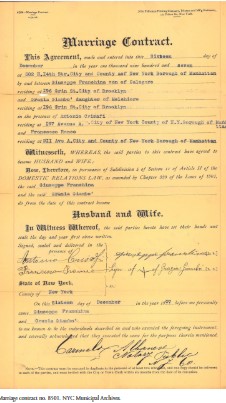
Marriage wasn’t always just a union between two people—it could also be a carefully negotiated financial arrangement between families. A marriage contract may identify property, children from earlier marriages, inheritance rights, relatives, trustees, and assets that the bride or groom brought into the marriage. For genealogists, the people and property named in the agreement can open doors to entirely new branches of research.
Introduction
A marriage contract is an agreement establishing financial, property, inheritance, or other legal arrangements connected with an upcoming marriage.
Depending upon the place and historical period, these agreements could address what property each spouse brought into the marriage, how that property would be controlled, what would happen if one spouse died, and how children or other heirs would be protected.
Some contracts were relatively simple agreements between the prospective bride and groom.
Others involved parents, relatives, guardians, trustees, or representatives of entire families.
That is what can make them particularly valuable to genealogists.
A marriage contract may document not only the couple—but the family and property relationships surrounding their marriage.
What Might a Marriage Contract Contain?
The contents vary tremendously, but a marriage contract might identify:
- Prospective bride and groom
- Their residences
- Parents
- Previous spouses
- Children from previous marriages
- Guardians
- Trustees
- Other relatives
- Property owned by the bride
- Property owned by the groom
- Land and real estate
- Money and financial assets
- Household goods
- Livestock
- Businesses
- Inheritance rights
- Dowry or marriage portions
- Property reserved for children
- Rights of a surviving spouse
- Witnesses
- Date the agreement was executed
- Signatures or marks of the parties
Some contracts can be extremely detailed.
A document created to protect property can unintentionally become a wonderful description of the people, possessions, and relationships within a family.
Why Was a Marriage Contract Created?
The simple answer is usually:
There was something worth protecting or defining.
One or both parties may have owned property before marriage.
The bride’s family may have wanted to protect property provided to her.
A widow or widower entering another marriage might want to preserve assets for children from a previous marriage.
Families might want to establish inheritance rights before the new marriage changed the legal relationships surrounding the property.
This is why the existence of a marriage contract itself can be a clue.
Ask:
Why did this particular couple need one?
The answer may lead directly to additional genealogical records.
Second Marriages Can Be Especially Interesting
A marriage contract involving a widow or widower deserves careful attention.
Suppose a widower with three children planned to remarry.
He might want certain property reserved for those children rather than allowing all of his assets to become entangled in the new marriage.
Likewise, a widow entering another marriage might possess property inherited from her deceased husband or property intended eventually for her children.
The contract may therefore identify:
- A previous spouse
- Children from the earlier marriage
- Property belonging to those children
- Guardians or trustees
- Inheritance arrangements
Suddenly, a document concerning a new marriage becomes evidence about an earlier family.
That makes marriage contracts particularly useful when reconstructing blended families.
Follow the Property
Property descriptions are not merely financial details.
They are genealogical clues.
If a marriage contract identifies land, determine how the bride or groom acquired it.
Was it inherited?
Purchased?
Given by a parent?
Received from a previous spouse?
Then search:
- Deeds
- Land records
- Probate files
- Wills
- Estate inventories
- Tax records
- Court records
Property mentioned in the marriage contract may connect several generations of a family.
A parcel of land can sometimes tell you more about family relationships than a surname does.
Pay Attention to the Bride’s Property
Marriage contracts can be especially useful for researching women.
Historically, marriage could significantly affect a woman’s legal control over property, although the laws varied considerably by jurisdiction and period.
A marriage contract might have been used to define or protect property belonging to the bride.
That property may have come from:
- Her parents
- An inheritance
- A previous husband
- Her own economic activity
- Another relative
If property is specifically identified as hers, investigate its origin.
It may provide the clue that identifies her parents or previous family relationships.
Trustees Can Be Genealogical Clues
Don’t skip over trustees or other people appointed to administer property.
A trustee might be:
- A brother
- Uncle
- Father
- Brother-in-law
- Family friend
- Attorney
- Business associate
The document may not explain the relationship.
That makes the trustee another person worth researching.
Why was this individual trusted with responsibility for the bride’s property or the family’s assets?
As with witnesses, bondsmen, and funeral attendees, the relationship may be more important than the title.
Witnesses Matter Too
Marriage contracts were legal documents and often required witnesses.
Research them.
Witnesses might be relatives, neighbors, business associates, attorneys, or people involved with the property described in the agreement.
If several unfamiliar people appear in the document, compare them with:
- Census neighbors
- Deeds
- Probate records
- Tax lists
- Court records
- Business directories
- Other marriage records
A seemingly unrelated witness can sometimes provide the connection needed to distinguish between two families with the same surname.
A Marriage Contract Is Not Proof the Marriage Happened
This is another member of our increasingly familiar Marriage Documents Abound family:
The document may precede the wedding.
A marriage contract establishes arrangements connected with an anticipated marriage.
That does not necessarily prove that the ceremony subsequently occurred.
Whenever possible, look for:
- Marriage certificate
- Marriage return
- Marriage register
- Church marriage record
- Newspaper announcement
- Other evidence that the couple actually married
As with marriage intentions, banns, bonds, and licenses:
Planned marriage and completed marriage are two different facts.
The Contract Date Is Not Necessarily the Marriage Date
A marriage contract could be executed before the wedding.
Therefore, don’t automatically enter the contract date as the marriage date in your family tree.
Record what the document actually says.
For example:
Marriage contract executed: June 3, 1842
Marriage: June 10, 1842
Those are two separate events.
The interval between them may also help narrow your search for the actual marriage record.
Marriage Contracts Can Lead to Probate Records
Whenever a marriage contract discusses inheritance or what should happen after a spouse dies, probate research should follow.
Look for wills and estate proceedings involving:
- Bride
- Groom
- Parents
- Previous spouses
- Trustees
- Children named in the agreement
Later probate proceedings may actually refer back to the marriage contract.
This can be particularly valuable when there was disagreement over property or inheritance.
A document created before the marriage may remain legally important decades later when one spouse dies.
Marriage Contracts Can Lead to Court Records
Property agreements sometimes produced disputes.
If descendants, surviving spouses, trustees, or heirs disagreed about the meaning of a marriage contract, the dispute might reach court.
Court files can contain:
- Copies of the original contract
- Depositions
- Family relationships
- Property descriptions
- Testimony
- Correspondence
- Statements about deceased relatives
The marriage contract may therefore be only the beginning of the documentary trail.
If the agreement contains complicated property or inheritance provisions, look for later litigation involving the people or property named in it.
Marriage Contract vs. Pre-Nuptial Agreement
The terms can overlap.
A modern pre-nuptial agreement is an agreement made before marriage establishing financial and property rights between prospective spouses.
Historically, however, the broader category of marriage contracts can encompass arrangements involving property settlements, inheritance provisions, dowries, children, trustees, and agreements involving other family members.
For genealogical research, it is useful to recognize the relationship between the two without assuming every historical marriage contract functioned exactly like a modern prenup.
Pre-Nuptial Agreements deserve their own examination because their terminology, purpose, and historical context can differ from the broader range of marriage contracts.
Where Might You Find Marriage Contracts?
Depending upon the jurisdiction and period, marriage contracts may be found among:
- Court records
- Deed books
- Land records
- Marriage records
- Probate collections
- Notarial records
- County clerk records
- Recorder’s office records
- Family papers
- State and provincial archives
- Local archives
- Historical societies
Don’t search only collections labeled Marriage Records.
Because these documents frequently concern property, a marriage contract may have been recorded with deeds or other property transactions.
Catalog terminology can also vary.
Search for terms such as:
- Marriage Contract
- Marriage Agreement
- Antenuptial Agreement
- Ante-Nuptial Agreement
- Marriage Settlement
- Property Settlement
- Marriage Articles
- Matrimonial Agreement
The terminology itself may vary substantially by place and period.
Follow Every Person and Every Piece of Property
Marriage contracts reward careful reading.
Don’t extract only the names of the bride and groom.
Create a list of:
People: parents, children, trustees, witnesses, previous spouses, relatives, attorneys.
Property: land, houses, businesses, money, inheritances, personal property.
Then investigate each one.
A marriage contract may have been created to settle financial matters before a wedding.
For the genealogist, however, it can become a roadmap connecting people, property, marriages, deaths, and generations.
Key Takeaways
- A marriage contract establishes financial, property, inheritance, or other arrangements associated with an anticipated marriage.
- Contracts can identify far more than the bride and groom, including parents, children, trustees, witnesses, and previous spouses.
- Second marriages can produce especially valuable contracts because property may need to be protected for children from earlier marriages.
- Property identified in the agreement can lead to deeds, probate files, tax records, and earlier generations.
- Property belonging to the bride may provide clues to her parents, inheritance, or previous marriage.
- Research trustees and witnesses rather than assuming they were merely legal participants.
- A marriage contract does not necessarily prove that the marriage occurred.
- The date of the contract should not automatically be treated as the marriage date.
- Probate and court records may contain later references to the marriage contract.
- Search property, deed, court, probate, and notarial collections—not just marriage collections.
- A pre-nuptial agreement is related to the marriage-contract concept, but it is useful enough to warrant its own Field Note.
- Follow every person and every piece of property named in the agreement.
Examples