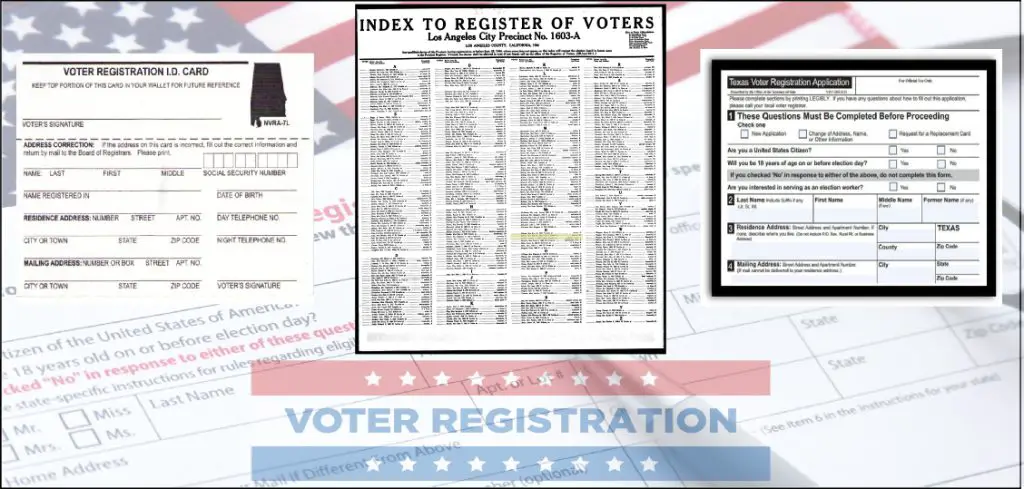
Voter registration records are available online and offline from all over the world and are what I consider a hidden gem of information that can assist you in advancing your family history and genealogy research.
Before I get to the 9 reasons why voter records are such a wonderful tool for researching (and finding) ancestors, let me tell you a little story about why they have been incredibly helpful for me:
I already knew who my great-great-grandfather was and his name was Louis Marks, but I did not know his parents’ names or the names of any siblings. But a Great Register – a fancy name for a voter registration list, was found for the city of San Francisco. And not only was he on it, but also was another person with the same surname, Emil Marks. Now there were many folks with that surname in San Francisco and I am not naive enough to think that they all were related. But in that Great Register, it included their naturalization date – and Louis and Emil were naturalized on the same day. That made my ears perk up so I researched further elsewhere and guess what – they had the same witnesses named in their naturalization index cards. Still doesn’t prove a blood relationship, so off I went to look at city directories for that time and I found an entry for a business named “Louis Marks and Bro,” under Emil’s entry where it stated that he was an owner as well. Sufficient to assume now that they were indeed brothers, right?
Sorry, we aren’t done but I will keep it short. Then I found a newspaper article where a Fanny Lust was handling the estate of Emil Marks, who was run over by a train in Oakland. Suspecting a possible blood relationship, I researched further but had no luck finding evidence of a sibling relationship between Fanny and the boys. In the meantime, I was contacted by a new “cousin”, who was a descendant of Fanny and he alerted me to the fact that her maiden name was “Marks.” Getting warmer! Then I found the obituary for Emil in the newspaper and lo and behold it listed his siblings as Louis, Mrs. S. Lust, and Mrs. I. Schudmack. Fanny had been married to a Simon Lust (who by the way had a business partner in the 1860s – one Emil Marks). So now we had evidence of a sibling relationship between Fanny, Louis, and Emil PLUS a bonus – another sister, who turned out to be named Lottie and was married to Isaac Schudmack!
All this was started and discovered over several years because of a Voter Record. End of story.
Here are 9 things that Voter Records can help you to find more about your ancestors:
They fill in the gaps between censuses – in the ten years between censuses – people move, they die, they get married, etc. The advantage of voter registration records is that they can tell you their address, their occupation, etc. And they are generally published annually.
Middle names – often a complete name is included in voter registration records – in fact the only place that I ever found my great grandfather’s middle name was in several of these records. Prior to finding them, I only knew his middle name as an initial.
You can find a spouse – after 1920 for all of America, women could vote – so at that time their names began to show up in Voter Registration records. Some states had passed women’s suffrage laws prior to 1920, but just a few. To be complete – women in some states in the late 1700’s had voting rights until they were all taken away by 1807. The given name of a woman is sometimes included in the voter registration record. For example, a Mary Smith who was married to a James Smith would be entered as Mrs. Mary Smith. If they both lived at the same address on the registration list, one could surmise that they were married to each other and you then could certainly search for better evidence; or they could be siblings or have a parent-child relationship. But at least there is a good possibility that they may indeed be married to each other.
Naturalization information – in some records from the 1800’s, the date and place of naturalization is included, which can provide leads for obtaining their detailed naturalization records.
Nativity – again in the 1800’s, the place of birth is entered, which is especially helpful for naturalized immigrants.
Physical Characteristics – California Great Registers were quite thorough and included age, height, complexion, eye and hair color, as well as any distinguishing marks or scars.
Political party or affiliation – usually abbreviated as Dem or Rep, but you will find other party names as well, in addition to “None”. Remember that Democrats and Republicans from years ago did not necessarily align with the same principles or policies as the parties do today.
Precinct captains and election workers – not available in voter registration records but certainly voting related. Look in newspapers and you will find many lists of election workers. Many of my ancestors worked in precincts to assist in the electoral process.
Migration – a few voter registration record sets include a question regarding how long the voter lived in the state, the county, and the precinct. This can be useful to determine when they moved, which can lead to additional research as to their whereabouts for census research as an example.
The Ancestor Hunt has links to about 1,300 Free Online Voter Record Collections! Check them out at Voter Records
If you’d like this information in a clean, printable, and well-organized reference format, this topic is also included in the Quicksheet Vault. The Vault is designed for researchers who prefer working tools they can save, print, and reuse — whether that means building a personal binder of key resources or keeping reliable references close at hand. Learn more about the 300+ Quicksheets in the Vault HERE
4 replies on “9 Reasons Why You Should Be Researching Voter Records”
Thanks for your comment
For the benefit of readers with Australian research, I’d like to add another reason for using electoral records. From about the 1920s until 1991, State electoral rolls for Queensland (at Qld State Archives) have hand-written annotations with details such as change of street address, or what electorate someone moved to, or the reason for their removal from the roll (death, insanity etc), or change of name (eg, when a woman married). This only applies to two of our four series of rolls (not the Commonwealth rolls on Ancestry).
Thank you Judy for providing this information, Excellent that these annotations are added. Very useful!