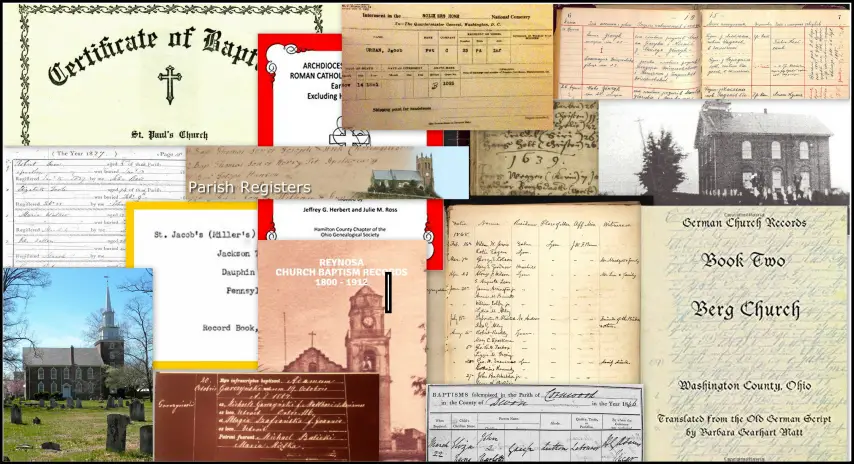
Before the recording of civil records and even now, Church Records have become a necessary and valuable category of collections that should be researched. They provide information that often cannot be found anywhere else. Baptisms, marriages, and funerals are commonly thought of when we discuss church records, but there is so much more. For example, I found the death date of one of my relatives in Berlin, Germany via a Church Newsletter!
Here is a list of the valuable information contained in Church Records and why you should be researching them:
- Baptisms and Christenings – Names of godparents and witnesses are often included as well as the names of the child and par- ents. parish where the family is residing, legitimacy of the child, etc. These additional names may provide relationship clues
- Marriages – church weddings are documented. In more modern times, witnesses are required in order to civilly record the marriage, and may be required in some religions.
- Deaths and Funerals – If the funeral “ceremony” is conducted in a church, it is generally recorded
- Burials – if it is a church-affiliated cemetery, the burial information will be recorded in the church’s records.
- Confirmations, Bar/Bat Mitzvahs – these are generally recorded by the church or synagogue
- Membership Lists – Members and congregants are kept in membership lists. These are quite useful to compare year to year, as an absence from the list may indicate that a member may have moved their residence, passed on, or joined another church.
- Admissions of New Members – will be recorded in the membership list and/or church newsletter. The date of entry may indi- cate when someone moved to a new location
- Transfers of Memberships Out of the Church – there even may be a formal document indicating that the member leaves in good standing with the church
- Letters of Introduction – a current church official might write to assist the member and family in joining a new church within the denomination, but in a different area
- Disciplinary Actions Against Members – might be recorded in the Church Minutes
- Dismissals – for whatever reason, an individual or family may be dismissed from the church. These would be recorded.
- Church Minutes – the church officials often would conduct meetings to discuss the administrative and business side of the church, and the meetings would be recorded in official minutes of the meetings
- Church Directories – similar to membership lists, these might include residence information and other contact information of the church clergy and all members.
- Sunday School Lists – lists of children who attend Sunday School, as well as the teacher’s name.
- Church Newsletters – regularly published documents that discuss events of the church, new members, transferring members, birthdays, anniversaries, births, marriages, and deaths of members
- Clergy Admissions and Dismissals – might be included in the church minutes; also, may be formal documents from the higher ups in the church organizational structure for a larger area
- Church Newspapers and Magazines – a more recent phenomenon; essentially another way, similar to a newsletter, to com- municate between the church and congregants and members
- Family Relationships – may be specifically documented in membership lists or can be determined from people attending bap- tisms, weddings, or funerals.
- Church Cemetery Records – includes name of deceased, date of death, burial date and place, sometimes age and cause of death.
- Newspaper Obituaries and Other Articles – Clues to church membership can be found in historical newspaper articles such as obituaries. Also, upcoming and past church events will be documented in newspapers.
Check out links to 9,700 Free Online Church Record Collections at The Ancestor Hunt’s Church Records page.
If you’d like this information in a clean, printable, and well-organized reference format, this topic is also included in the Quicksheet Vault. The Vault is designed for researchers who prefer working tools they can save, print, and reuse — whether that means building a personal binder of key resources or keeping reliable references close at hand. You can learn more about the Quicksheet Vault HERE